Dates
Overview
Expedition Highlights
- A voyage specially-tailored for English-speaking travelers including discussions with experts, transfers before and after your cruise, and an included excursion in each port of call.
- Engaging lectures and discussions on board with two Smithsonian Journeys Experts, including expert in the classics Janet Duncan Jones and cultural and linguistic anthropologist Kerri Lesh.
- A cruise to discover the landscapes, architecture, and rich cultural history of Southern Spain.
- UNESCO World Heritage sites en route: the Alcázar in Seville from Cádiz, the Alhambra in Granada from Malaga, and La Lonja de la Seda in Valencia.
- A discovery of the Balearic Islands with a stop in Palma de Mallorca, their capital.
- A flamenco performance in Cadiz.
- A tasting of Algarve wines in Lagos.
Itinerary
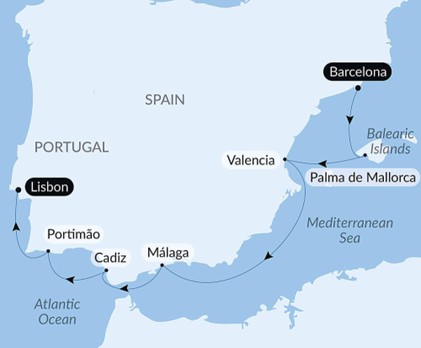
DAY 1 – Barcelona, Spain
Located on the seashore between the mountains of Montjuïc and Tibidabo, Barcelona offers its many visitors a perfect blend of tradition and modernism. Truly an open-air museum, the “prodigious town” reveals an astonishing range of artistic treasures and museums, combining Roman ruins, medieval districts and a number of avant-garde elements from the 20th Century. Over the years, it has been marked by some of the greatest artists, such as Picasso, Miró or Gaudí, most of whose work has been listed as World Heritage Sites by UNESCO. Take the time to stroll along the Ramblas and enjoy the gentle, typically Mediterranean lifestyle of the capital of Catalonia.
Day 2 – Palma de Mallorca, Balearic Islands
Palma de Mallorca will reveal its many treasures: idyllic coves, majestic limestone cliffs that plunge into the clear sapphire- and turquoise-colored waters of the Mediterranean, and vast plains planted with almond trees, olive trees and vineyards. When your ship calls at the capital of the Balearic Islands, take a walk to discover its emblematic monuments, such as its famous cathedral, and amble through its old streets. Here, like a painting, the island’s historical heritage forms a backdrop to the lively and warm cosmopolitan atmosphere of the Mediterranean.
Day 3 – Valencia, Spain
Valencia – the city of Art and Sciences. Two hearts beat in this Spanish city: one is modern, avantgarde and almost futuristic; the other is more provincial, more traditional and nostalgic. Valencia has the temperament of a great Mediterranean city whose wide avenues form a border around the old town. The city has an abundance of architectural styles that coexist harmoniously, but above all it resolutely embraces the 21st Century with the futuristic structures of its Agora congress center and City of Arts and Sciences, emerging from a crystal blue pool.
Day 4 – At sea
Day 5 – Málaga, Spain
A historical and festive town, Malaga is in Andalusia, on the Costa del Sol. Between the marina and the beaches, the seaside promenade of La Farola offers an ideal setting for strolling and relaxing. Set slightly further back, the Malagueta bullring is one of the emblematic sites of the city. From the hill overlooking the old town, one can see Gibralfaro castle and the Alcazaba, two fortified ensembles rising out from the cypresses and maritime pines. To visit Pablo Picasso’s birthplace, you will go first to the courtly plaza de la Merced. A few streets back from here, you can explore the museum dedicated to the artist, in the Buenavista palace.
Day 6 – Cadiz, Spain
Andalusia’s Cadiz is located on the Costa de la Luz, in the south-west of Spain. From the beaches of Cortadura, to the flamenco bars of Santa Maria, through the colorful streets of la Viña, you will be amazed by this city, which is both steeped in history and extremely festive. In the medieval El Pópulo district, you will stroll along covered passages in the narrow gaps between houses. You will also be able to mosey around the lush Mina square. The star of the show is the magnificent cathedral and its dome crowned with yellow porcelain, presiding above the Ocean.
Day 7 – Portimão
At the entrance of the River Arade, Portimão is a former sardine port that has become a famous seaside city. From this pleasant town, you can explore Silves, the former capital of the Algarve. The town is dominated by a Moorish castle, one of the best preserved in Portugal. You can also admire the incredible cathedral with its baroque façade, built on the site of an old mosque. Then you will go to Monchique, a small mountain town surrounded by a forest lush eucalyptus and cork oaks. In the maze of narrow cobbled streets and whitewashed houses, you will discover here a wilder and more authentic Algarve.
Day 8 – Lisbon
Portugal’s capital city located on the banks of the Tagus, only a few kilometers from the Atlantic coast, is a city of exceptionally rich cultural diversity. At the mouth of the river harbor, impose two UNESCO World Heritage monuments, Jeronimos monastery and Belem tower. The Alfama hillside is also worth visiting: known for its fado bars and its Moorish streets, this district is the oldest one of the city and one of the most typical. Not far from there, Chiado’s elegant streets are home to big fashion labels and are an invitation to a bit of luxury shopping.